If you’ve been online in the Philippines this year, you’ve probably seen the name Pax Silica pop up somewhere. Maybe in a news headline about billions in investment. Maybe in a protest photo from Tarlac. Both are about the same thing: a huge US-backed tech hub that the government wants to build in New Clark City.
I went through the announcements, the government’s own projections and the criticism to figure out what’s actually on the table. Short version: the upside is real, and so are the problems. Here’s what I found.
First, what is Pax Silica?
Pax Silica is a US State Department initiative launched in Washington on December 12, 2025. The idea is simple enough: get friendly countries to build a supply chain for chips, AI hardware and the critical minerals behind them, so they depend less on China. China controls most of the world’s rare earth refining, and it showed in 2025 that it’s willing to use that as leverage.
The founding group was small: the US, Japan, South Korea, Singapore, Australia, Israel and the UK. It has since grown to more than two dozen signatories. The declaration they sign is non-binding. Jacob Helberg, the US official behind it, likes to frame it as a new era where “the 21st century runs on compute and the minerals that feed it.”
The Philippines signed on in April 2026. And unlike most members, we’re not just endorsing a document. We’re hosting the first physical project.
What’s actually planned in Tarlac
The plan is a 1,620-hectare (about 4,000 acres) “Economic Security Zone” inside New Clark City, part of the Luzon Economic Corridor. Washington calls it the first “AI-native industrial acceleration hub” under Pax Silica. The Bases Conversion and Development Authority (BCDA), which manages New Clark City, says it would bring together chip design, fabrication and advanced packaging, AI computing, critical mineral processing, energy and data infrastructure, R&D, logistics, and even housing and commercial areas.
Timeline-wise, nothing is being built yet. BCDA chief Joshua Bingcang says 2026 is for negotiating with partners, 2027 for planning, and construction starts in 2028. The framework agreement with the US is expected around November this year.
The case for it
We finally get to move up the chip ladder
This is the strongest argument, and it’s not a new one. The Philippines has been in the semiconductor business for decades, but mostly at the tail end: assembly, testing and packaging. It’s a big business for us. Electronics made up more than half of the country’s merchandise exports in 2024, around $39.1 billion. But the design and fabrication work, where most of the money and know-how sit, happens somewhere else.
The government is pitching Pax Silica as the way out of that. Bingcang’s line is that minerals should be processed “at the source” and turned into finished products here, instead of being shipped out raw. Finance Secretary Frederick Go said much the same thing when we joined. If even part of that happens, it would be a real change for Filipino engineers and computer science grads who currently have to leave the country to do this kind of work.

The numbers are enormous, if they hold
BCDA’s projections at full development: $40 billion to $70 billion in investment (with $10 billion as the initial target), 130,000 to 190,000 direct jobs, another 500,000 to 800,000 indirect ones, and up to $200 billion in exports. It also expects ₱68 to 75 billion a year in withholding taxes and around ₱60 billion in lease income over 25 years. Bingcang says more than 50 companies are interested, including some “trillion-dollar tech titans,” and one is already doing site evaluation.
Those are projections, not promises, and I’ll come back to that. But even a fraction of them would matter for a country whose best tech talent keeps getting exported.
The land stays ours, at least on paper
A lot of the early fear was that this would turn into a foreign enclave. BCDA’s answer is that the land stays with the Philippine government. Investors can lease it for up to 99 years under the amended Investors’ Lease Act (RA 12252), but nothing is sold. Bingcang has also said the project is “purely commercial,” with no defense manufacturing, and that it falls under Philippine law and environmental rules.
It could force some overdue infrastructure
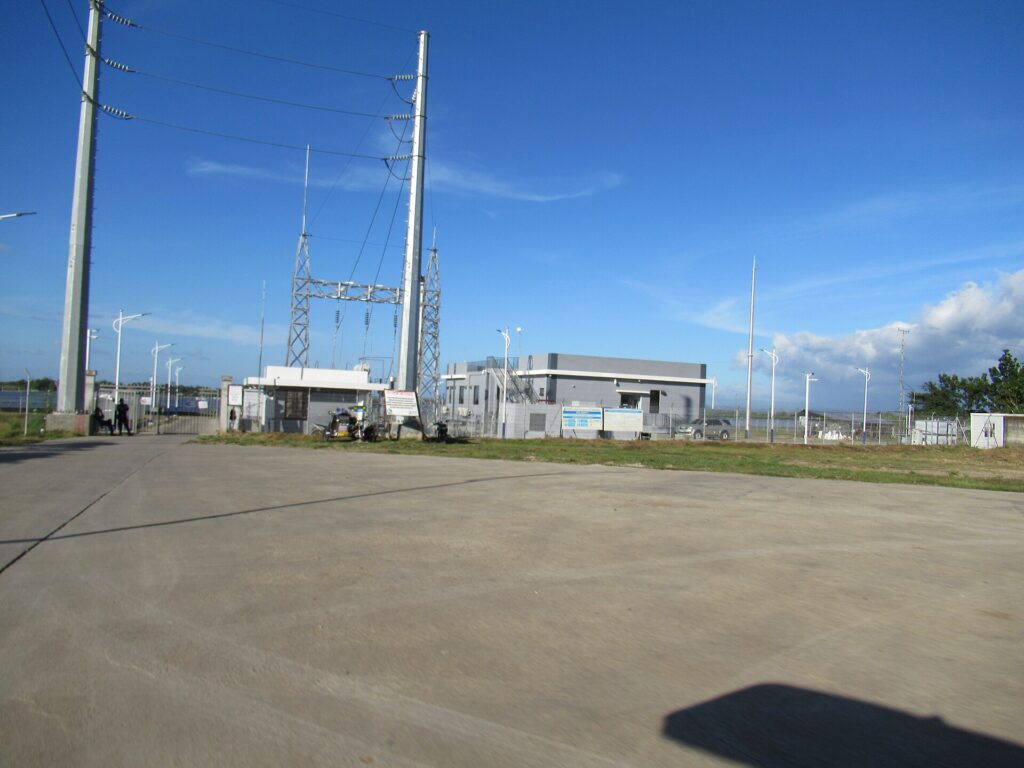
A project this size can’t run on the grid we have now, so it comes with its own energy plans: a 500 MW solar project with Saudi Arabia’s ACWA Power that’s already underway in New Clark City, a proposed LNG plant and pipeline linking Subic and Clark, and early talks with Japanese and Korean companies. If that power is genuinely added capacity and not taken from the existing grid, Central Luzon benefits too.
The case against it
The power bill is the elephant in the room
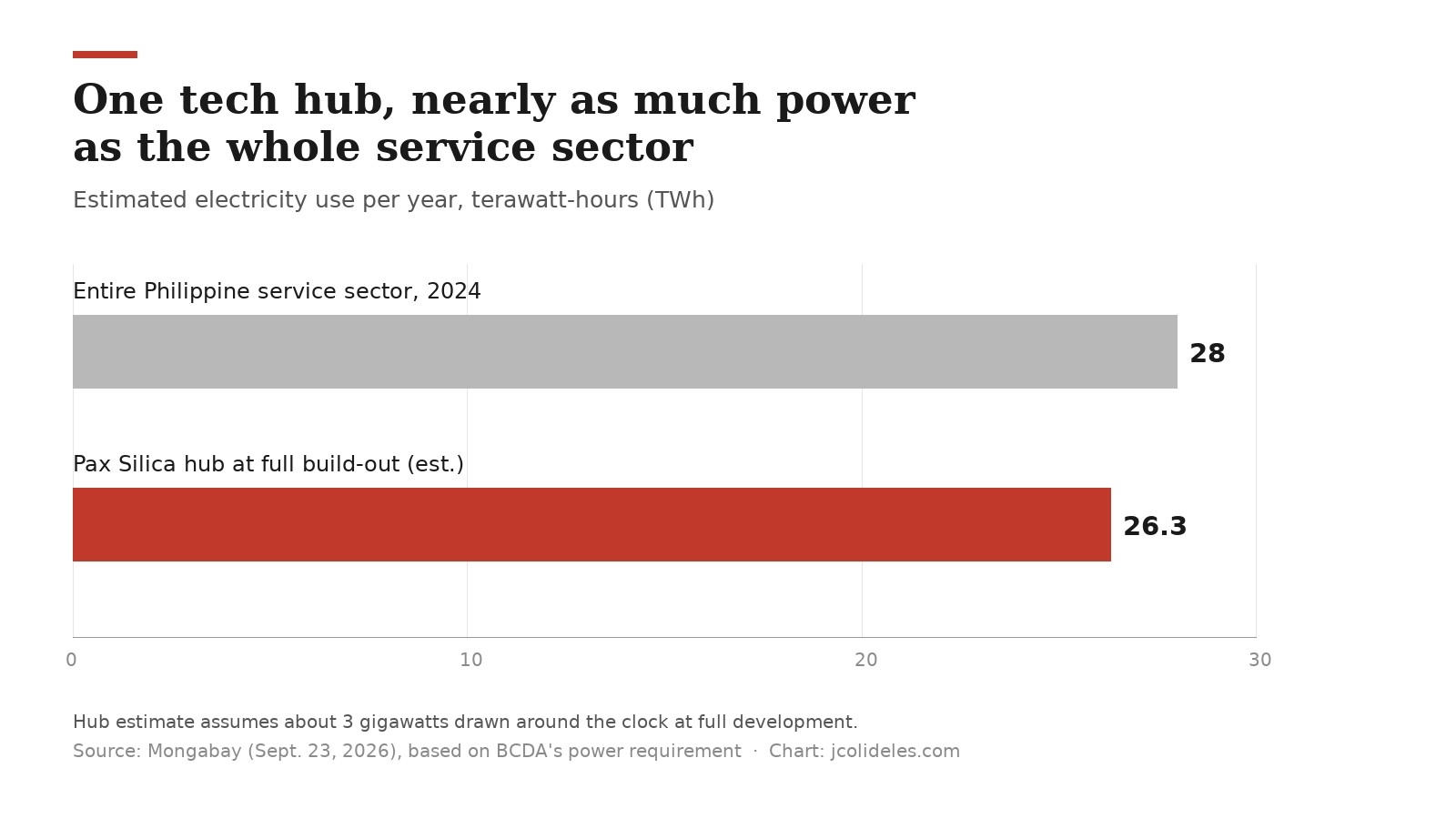
At full build-out, the hub would need about 3 gigawatts of electricity, according to BCDA’s July briefing. (In June, Bingcang had mentioned 5,000 MW of generating capacity, so even the official figure moves around.) Mongabay worked out that this comes to roughly 26.3 terawatt-hours a year. For comparison, the entire Philippine service sector used about 28 TWh in 2024. That’s one industrial zone using almost as much power as every mall, office, hospital and school in the country combined.
And we’re starting from a bad place. The Department of Energy says the average power rate hit ₱12.43 per kWh in June 2026, the highest in Southeast Asia, slightly above even Singapore. The chip industry itself keeps complaining about outages and costs. Solar helps, but covering 3 GW with panels means thousands more hectares of land. Nobody has fully explained how this gets built without pushing prices up for everyone else.

Water, in a province that farms
Chip plants use a lot of water. BCDA says its system will start at 120 million liters a day and can scale to 300 million, using harvested surface water and recycling instead of groundwater. Mongabay’s reporting put the projected use at 60 to 90 million liters daily. Either way, critics point out that December to May is dry season in Central Luzon, which is exactly when farmers need irrigation most.
The Aeta question hasn’t been answered
This is the part that bothers me most. Aeta communities say the hub overlaps land they’ve claimed as ancestral domain, including at least three existing villages. They’ve been applying for a Certificate of Ancestral Domain Title since 1994, and it still hasn’t been issued. BCDA’s position is that “there is no ancestral domain title in that area.”
Both statements can be technically true at the same time, and that’s the problem. A title that’s been stuck for 30 years isn’t proof that nobody lives there. Things got ugly at a public forum on September 10: activists reported 27 protesters hurt and five arrested, while police said 16 officers were injured.
“Joint governance” still has no fine print
The US Embassy has described the zone as run under “joint governance” between the two countries, with frameworks still to be identified. As of mid-2026, construction costs, exact boundaries, staffing and anchor tenants were all still undefined. And because BCDA is structuring it as a commercial contract rather than a treaty, it won’t go through Senate ratification. That’s faster, but it also means less scrutiny from elected officials. Even the Management Association of the Philippines, which supports Pax Silica, is asking for written guarantees: Philippine law, taxes, labor standards and courts should apply to everything in the zone, and there should be an independent body tracking whether the promised jobs and technology transfer actually happen.
When the business community is asking for safeguards too, it’s not just activists being difficult.
We could end up doing the cheap part again
Groups like Kilusang Magbubukid ng Pilipinas, the Computer Professionals’ Union and the Makabayan bloc argue the opposite of the government: that we’ll end up supplying minerals and low-value assembly while the valuable parts, and the profits, stay abroad. BAN Toxics has also flagged that the plans for mineral processing don’t say much about waste. Given how our mining and old special economic zones have gone, including the contamination left behind at the former US bases in Clark and Subic, the skepticism is earned.
China is watching
Beijing clearly isn’t happy. A July opinion piece in the state-run Global Times called the initiative a “Silicon Curtain” and described the Philippines as a “sacrificial pawn” in US plans for the region. Some critics here also worry that a strategic tech hub next to expanding US-Philippine military cooperation could become a target if things ever escalate. You don’t have to buy Beijing’s framing to see that the project raises the stakes in an already tense relationship.
So, is it a good deal?
Honestly, it’s too early to say, and anyone who tells you it’s obviously great or obviously a sellout is getting ahead of the facts. The deal hasn’t been signed. Most of the big numbers come from the agency that’s selling the project. And the hardest questions, about power, water, land and who’s actually in charge, don’t have public answers yet.
What I’d want to see before November:
- The full framework agreement released to the public, not just summarized in press briefings.
- A clear power plan that adds new capacity instead of competing with households for what’s already on the grid.
- The Aeta land claims settled properly, with real free, prior and informed consent, before anything gets built.
- Specific targets for technology transfer and Filipino hires in technical and leadership roles, checked by someone independent.
If those boxes get ticked, Pax Silica could be the biggest step forward for Philippine tech in a generation. If they don’t, we risk repeating an old pattern: big promises, the land and the water go, and the good jobs stay somewhere else. I’ll keep updating this post as the details come out.
References
- Wikipedia contributors. “Pax Silica.” Wikipedia. Accessed September 26, 2026.
- US Department of State. “The United States and the Philippines Launch Plans for 4,000-Acre Economic Security Zone to Shore Up Supply Chains.” April 2026.
- Gonzales, Gelo. “What is Pax Silica? What are its goals, and what concerns does it raise?” Rappler, April 22, 2026.
- Sinaking, Erika Mae P. “BCDA pegs Pax Silica investment at up to $70B.” BusinessWorld, July 24, 2026.
- Ramirez, Renalyn. “Pax Silica investors may lease New Clark land for 99 years – BCDA.” Philstar.com, July 24, 2026.
- Reuters. “Philippines business group backs Pax Silica, calls for sovereignty protections.” BusinessWorld, July 30, 2026.
- Talavera, Sheldeen Joy. “DoE says Philippine electricity rates highest in Southeast Asia in June.” BusinessWorld, July 21, 2026.
- Beltran, Michael. “Planned US tech hub in Philippines hit over environmental and Indigenous land concerns.” Mongabay, September 23, 2026.
- Ramer, Eddie. “Pax Silica and the Philippines: What the New Economic Security Zone Means for Global Supply Chains.” Avasant, May 2026.
- Domingo, Ronnel W. “50 firms keen on PH ‘Pax Silica’ hub.” Philippine Daily Inquirer, June 17, 2026.
- Global Times. “Pax Silica only makes the Philippines a sacrificial pawn in US Asia-Pacific designs.” Global Times, July 14, 2026.
Featured image: New Clark City Sports Hub, aerial view, by the Bases Conversion and Development Authority (public domain), via Wikimedia Commons. Figures are as reported up to September 26, 2026, and may change once the framework agreement is signed.
.jpg)